|
|
| |
|
 |
| |
|
|
B R O A D W A Y |
|
La Cage Aux Folles
|
|
by Jeannie Lieberman
|
|
The revival of La Cage Aux Folles is brightening Broadway’s season of grungy, mini and/or mindless musicals. A sprightly elf in the person of Jerry Herman sent us a bold and brilliantly wrapped Christmas present imbued with hope and optimism and lavished with enough love to melt even the most dour amongst us with its warmth.
Indeed a trip to the Marquis theater is like coming upon a feast and not realizing how hungry you were…hungry for glitz and glamour, feathers ands furs, high hair and high kicks, tits and ass, mascara and moxie – so what if it is all male…they look like every woman’s dream and every man’s fantasy.
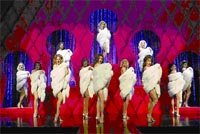
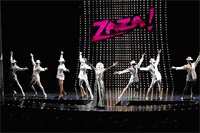
The show opens with an exuberantly over the top introduction of Les Cagelles, a dozen long stemmed chorines who emerge one by one from Scott Pask’s snazzy set, gorgeously draped in William Ivey Long’s fabulous furs and sexy sequins. They go from sassy strutting to an old fashioned tap dance to a chorus line energetic enough to put the Rockettes to shame, culminating (at last!) with the show’s anthem “We Are What We Are”. While that is going on the story unfolds backstage in this well constructed musical, as the show’s star, ZaZa, prepares for her big number “A Little More Mascara” illustrating “her” (his) stunning transformation into an onstage diva.
Harvey Fierstein’s unique book might have been relegated to cable sitcom status in its free wheeling splash into gay culture, with all the angst and attitude that takes place within and above a gay nightclub, until Herman musicalized the humor with heart and hope. It’s message, essentially that love and family values are universal no matter what the gender, in this case between two men, might have been shocking when the show opened in 1983, when AIDS surfaced, but has become seemingly acceptable (barring a recent unfortunate crimson colored backlash) and Fierstein, seems to be on a one man crusade to prove it as he recently morphed from playing a doting mother in the wholesome Hairspray, to the doting patriarch in Fiddler on the Roof.
The story, based on a French farce by Jean Poiret, then turned into a delightful French movie and an only slightly less delightful American one, “The Bird Cage” is at once warm and fuzzy, iconoclastic and cutting as he pits the culture clash of gay family versus that of a straight as the families in crises work through it. Young Jean Michel, the biological son of Georges, owner of the infamous cross dressing nightclub, “La Cage”, announces that his fiancee’s politically correct family is coming that night for dinner, especially her homophobic father whose political campaign puts their very lifestyle at risk. Fearing their disapproval and the loss of his love, Anne, the young man insists that both the gay decor and his adoptive “mother”, Albin (the show’s star, “ZaZa”), be exiled for the evening.
The situation is fraught with tension as Daniel Davis, the debonaire father, must tell the crushing news to his long time love, Gary Beach, (both of whom deliver Tony Award winning performances) and generously seasoned with humor as the “maid” must become a butler and their home is transformed from lascivious den to monastery. Gavin Creel is the golden voiced young man who discovers the true meaning of love and family in a hilarious quagmire of identity crises and political practicality.
The production boasts first class creators: William Ivey Long at his sequined best, Scott Pask’s ingenious imaginative sets which inspired applause and sometomes laughs even alone, veteran director Jerry Zaks who tweaked and teased the production creating a blur of activity which made the night fly by too soon.
But it is the genius of Jerry Herman’s achingly romantic and firmly defiant score that assures this musical’s status as one of our finest. The score is suffused with love oozing out of every song and Herman assures that we will walk out singing them by limiting the number of songs and repeating them in different contexts throughout the show. When Jean Michel tries to impress his father with his love for his fiancee he sings, in a brilliant rewrite for this production “With Ann on My Arm”. Armand later sings it to Albin, as originally written, “With You on My Arm’ and, thus, a universal love song is born. Later on Georges, trying to impress Jean Michel of Albin’s devotion to him, sings “Look Over There” chastising boy about not appreciating her, later changes viewpoint as Jean Michel no longer self centered and, in one of the show’s most touching moments, now enlightened, repeats it himself to Albin, another example of Herman brilliantly conveying the emotional involvement of characters.
|
 |
|
The prime example of repeating a song twice for dramatic impact is the show’s most significant song, “We Are Who We Are” an anthem for all those who dare to be different, first sung by the Cagelles as they proudly take off their wigs.at the end of the number. Later the maligned Albin turns it into a fierce, heart wrenching statement after he is asked to conceal his identity by Jean Michel, internalizing the song with intensity to close Act I. “I Am what I Am”. But there are some songs, with the Herman touch for tapping directly into the bloodstream, that do not require repetition to be memorable, as any beach lover will testify, the “Song on the Sand”, daring in its jettisoning of lyrics at one point to convey feeling. And, of course, the memorable “The Best of Times” which epitomizes Jerry Herman’s unquenchable optimism.
Davis, the surprise in the casting, looking quite handsome, his full throated baritone, enhanced by his acting ability gave romance to the role of Armand, and Gavin Creel was sweet sexy and boyish as his son. The only non surprise in the show was Gary Beach, who seemed to have sashayed over and rubber stamped the cross dressing role he created in The Producers without missing a beat, or snagging a nylon. Perhaps over eager in the show’s first week, a later visit indicated that Beach did indeed rachet it down a notch so that there was dramatic contrast between his Albin and ZsaZsa, not immediately evident at show’s opening.
Those who value substance over style will have much with which to quibble. It is as if talented choreographer Jerry Mitchell, has opened his immense bag of terpsichorean tricks with no one to help him choose which and when, certainly not director Zaks nor enablers Long and Pask, who enhanced each number in happy compliance with special sets and spectacular costumes (an actual cage which houses a sinuous “bird” dancer, feathers draped everywhere, dancers flying overhead, a Can Can number so prolonged as to give a cardiologist fright) The look: Las Vegas meets Cirque de Soleil, is very far removed from the intimate St.Tropez boite in which the show is supposed to take place..
ZsaZsa’s dramatic delivery of “I Am What I Am” is preceded by such a long dance number that its message is seriously mitigated and one forgets what inspired it. The result is a show weakened by wrong proportions between dance and drama as huge production numbers lose sight of their purpose and weaken the impact of the story and Mitchell’s lack of objectivity has damaged the pace of show.
However, mention must go to Larry Blank, who created those immaculately clean, concise additional orchestrations keeping seemingly endless dance numbers from getting dull. Jim Tyler’s original orchestrations, Don Pippin’s vocal arrangements and David Krane’s dance music arrangements keep the musical sounding fresh under the watchful eye of Music Director Patrick Vaccariello.
Personally, I can never get too much of a good thing, and revivals traditionally fall into the trap of becoming broader than the original, but there are those who must wonder whether they are seeing a Revue or a Musical. At any rate the show definitely offers its money’s worth. Cage’s climax is as much fun as it is fantastic as the girl’s uptight father (Broadway favorite Michael Mulheren) escapes in the guise of the very characters he abhored.
Gorgeous is the word for everything, and warm is the feeling you get as you leave singing the show’s sunny anthem “The Best of Times... is now!”.
La Cage aux Folles Tickets at Marquis Theatre
Marquis Theater, Broadway & 45 Street, 212 307-4100
Jeanne Lieberman (hrmjeannie@aol.com) is editor/senior reviewer of Theaterscene.net and can be heard on WFAS AM.
photos provided by Jeannie Lieberman
|
|
|
|