 |
|
photo by Joan Marcus
|
|
The following is an updated version of the original review posted 3/3/04:
The more things change the more they are the same. With "Sanctity of marriage" glaring from today's headlines and religious differences fuelling global unrest, and concerns for tradition defining borders, this musical couldn't be more timely. Yet it is based on two short stories written by Sholom Aleichem, a Yiddish short-story writer, dramatist, and humorist, who was born in Russia in 1859. They inspired Joseph Stein to incorporate them into a musical given warmth and life by composer Sheldon Harnick and lyricist Jerry Boch over forty years ago. One new song, "Topsy Turvy," was written for Yentl in the second act, the first time Harnick and Bock have worked together since 1970 after seven musicals, including " Fiorello!" and "She Loves Me." The able cast of 40 is a testimony to the confidence of the show's brave producers whose faith in their production is equal to Tevye's commitment to his own.
Those who saw the original in l964 (which ran for 3,242 performances, astonishing by todays standards), the 1971 movie or its more recent incarnation at Lincoln Center in l981 are now bringing their own families to share it. The score, with songs like "Sunrise, Sunset" and "If I Were A Rich Man", is so familiar that for many people "the music is in their inner ear even before they realize it springs out of this wonderful book," says director David Leveaux While today's audience's may be cerebrally stimulated by the cleverness of Ave Q, the quirkiness of Putnam County Spelling Bee, the pizzazz of La Cage Aux Folles, there is no rival for touching the heart and soul as Fiddler does. This quality has proved indestructible, retaining its original warm flavor despite the tendency of Brit directors to turn our sunniest musicals dark. It has also survived, with slightly less success, Mr. Leveaux's attempt to downplay Fiddler's ethnicity, aided by casting director Jim Carnahan (!), resulting in accent/mannerism free performances from a mostly non-Jewish cast. With some of the spice missing it does illustrate how this show has thrived multi-culturally throughout the world. Leveaux stated "I think the hook for the audience is the notion of how children transform the world of their parents".
Restaged with a simplicity that matches its story, the orchestra is inconspicuously stage left. In this redefinition set designer Tom Pye has borrowed the Chekovian white birches to blur the outlines between the home, the village and surrounding rustic environment which also houses their Russian neighbors, juxtaposing the two separate but, here, occasionally interrelated cultures. Pye has even projected the village far into the wings even though it is only discernible by a few audience members. The beauty of this arrangement allows one to see not just Tevye's wife lighting the Sabbath candles, but others in the village as they all sing the beautifully haunting "Sabbath Prayer".
The setting is 1905, ironically the year that Sholom Aleichem fled Russia to escape the pogroms that take place in this show. Brian McDevitt's twinkling lanterns, rise and fall overhead, in charming enchantment. A fiddler is perched, Chagall-esque, precariously on the "roof" (a beautifully thought out abstraction hovering over head.) With the plaintive strains of his violin setting the mood, the villagers silently appear in Vicki Ortimer's authentic, rough hewned costumes which are like little portraits themselves.
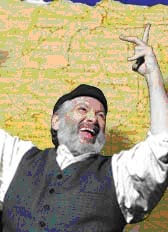
Tevye, downstage, lovingly describes his village and introduces its people to the audience. Then suddenly he turns, raises his arms and stamps his foot, the glorious score begins and the stage bursts into heart pounding vitality… and we're off into this alternately joyous/heart rending story of one man's family in Anatevka, a shtetl (village) in the Czar's Russia as revolution is brewing outside and, as we learn, inside this self contained town.
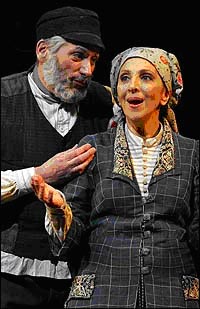
The time honored roles on which the story rests are beautifully, if rigidly, stated in the brilliant "Tradition". Rules are about to be challenged and reexamined by the Papa the Momma and their daughters, of which he had five (a great burden for a poor milkman as dowry's dictated desirability). Marriages were arranged by a professional matchmaker, Yentl ( Nancy Opel). As primitive as this might seem (it is still practiced today among Orthodox Jews and other cultures) these values were not questioned (and divorce was not an issue). In "Matchmaker" the hearts of the minds of these young girls are revealed as they timidly address their hopes and fears over the choices made for them. A faint feminism, born of private apprehension, is tentatively voiced, the notion of love, which will rend the fabric of their society as it begins to crumble. A wealthy widower, the butcher, Lazar Wolfe (David Wohl) decided to end his loniness by asking the matchmaker to arrange for hum to marry Tevye's oldest daugter Tzeitle (Sally Murphy who looks as Irish as her name). For the impoverished Tevye and Golda this is indeed an impressive match and a rousing negotiation between Tevye and the butcher at the local tavern soon turns into drunken revelry. Jonathan Butterell's faithful restaging of Jerome Robbins' signature choreography (the source of which can be enjoyed at Chasidic weddings today) cleverly introduces the outside element, the young Russian soldiers also frequenting the tavern, who desire/demand to join in the celebration. In a brilliant moment, which states the complexity and the first indication of the threat to come, a young officer extends his hand to Tevye to dance with him…the hesitation and tension is palpable as Tevye reluctantly reciprocates and inexorably gets drawn into the camaraderie of dance partners. Robbins used dance to make the political statement is brilliantly as the lines of Jewish men and Russian soldiers intertweave in mutual, if alcoholic, exuberance.
But Tzeitel's dismay at not marrying her childhood companion and soul mate Motel (multiple award winning John Cariani) the timid tailor, both surprises and melts Tevye's heart and he breaks the agreement, unheard of, to Golde in the phantasmagoric, fabricated nightmare in which Lazars widow (Joy Hermalyn) dictates in a dream that Tzeitel should marry the tailer. It is both clever and funny and the dream is peopled with painter Marc Chagall's animal characters and skewed perspective.
Their wedding is a short story in itself as it transcends from joyous celebration to antagonism between Wolf and Tevye over the broken vow to the destruction and fear as the pogrom begins. The fiddle is off balance now as Act I ends sorrowfully.
Tevye's second daughter Hodel (Laura Shoop) squeezes through the newly opened a crack in the wall of tradition by announcing, not asking, for his blessing to marry the visiting young rebellious scholar, Perchik (Paul Anthony Stewart). But the third, Chava (Tricia Pelluccio) breaks the bond goes too far falling in love with young Russian Fyedka (Patrick Heusinger) and Tevye, in a struggle between his heart and his faith, accedes to the latter and, heartbroken, excommunicates her from the family ("if I bend this far I will break").
Issues pale as the Constable announces the incredulous but firm edict that the entire village must "disappear in three days". Powerless they disband, Tzeitel to Warsaw (and we know the fate that awaits her family), Lazar to Chicago, Hodel and Perchik to Siberia, Yentle to Jerusalem, Tevya, Golde, Motel Tzeitle and their baby, and the others to relatives whom they have no time to contact in America.
In a sad and stunning finale we see them trudge away from their beloved village and lives with their meager belongings in silhouette across stage back to the sad strains of "Anatevka". Against a symbolically setting sun the ancient fiddler hands over his instrument to a young boy to take on the journey. It is heart stopping in its significance and simplicity.
Lest the show end on that plaintiff note the cast performs an exuberant hora for their finale.
Postcript: Jerome Robbins 91 year old sister, who launched his career, died in her seat minutes before the opening night curtain. She, alone, would have remembered the shtetl life represented in the show.
Fiddler On The Roof Tickets at Minskoff Theatre
Minskoff Theater, 200 West 45 Street, 212 307-4100
Jeanne Lieberman (hrmjeannie@aol.com) is editor/senior reviewer of Theaterscene.net and can be heard on WFAS AM.
photos provided by Jeannie Lieberman
|