|
|
| |
|
|
 |
| |
|
|
Rose Levine Struts Her Stuff
In NYC to Benefit SAGE |
|
by Bruce-Michael Gelbert
|
|
 |
|
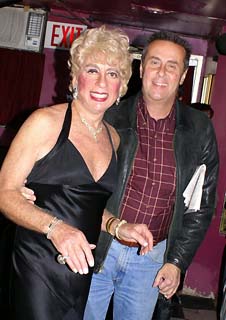
Rose Levine & director Richard Bell
photo by Joseph R. Saporito |
|
Rose Levine, diva of New York City, Fire Island and South Florida, brought her show, "Lullaby of Broadway," to Manhattan's Don't Tell Mama on October 27 as a benefit for SAGE (Senior Action in a Gay Environment). Richard Bell directed; George McGarvey designed the setting of gold records and feather boas; and Michael Kevin Walsh was the pianist, who opened with the "Lullaby of Rose Levine," to the tune of "Lullaby of Broadway," and, with "All I Care about Is Love," from "Chicago," explained why he indulged his divas.
Rose entered with a rousing "Gee, But It's Good to Be Here," with a big high note at the end, and taking her place center stage, told us, "I'm Happy." She paid tribute to Ethel Merman by belting out a gutsy "Some People," from "Gypsy," and "I Got the Sun in the Morning (and the moon at night)," from "Annie Get Your Gun," from which she also captured the intimacy of "I Got Lost in His Arms." She became "Call Me Madam"'s "Hostess with the Mostes' on the Ball," in elegant attire, and embraced life anew in "World Take Me Back," a song which Jerry Herman wrote for Ethel Merman, taking the title role in "Hello, Dolly!" late in its initial Broadway run, and which he credits Rose with keeping alive, as she does so much of the wonderful music she sings.
|
|
|
|
La Levine saluted Fanny Brice with "Oy, How I Hate that Fellow Nathan," about a beau who treats her badly, and, donning braids and feather, with "I'm an Indian" ("a Yiddische squaw"). Rose did Barbra Streisand doing "funny girl" Brice with "Second Hand Rose," perched on the piano and capping the song with a ringing top note; "I'd Rather Be Blue over You than Happy with Somebody Else;" and, from "Funny Lady," "How Lucky Can You Get."
Rose honored the Great White Way itself, cautioning, "Please, don't monkey with " Broadway," and, from "Follies," declaring herself a "Broadway Baby" ("singing like Miss Merman/with songs by Jerry Herman"). She played "It Had to Be You," which she recorded in an amusement arcade booth as a child, to introduce her sensitive singing of the song in this afternoon show and followed it with "Almost Like Being in Love," from "Brigadoon." Rose had a fling with operetta, in Gilbert and Sullivan's "Ruddigore," for the Arts Project of Cherry Grove, and, here, made another lusty foray into the genre, with Victor Herbert's "Art Is Calling for Me" ("I want to be a prima donna, donna, donna"), from "The Enchantress."
Rose began "I Love a Piano" stretched out on the instrument's lid and then took a place on the bench, beside Walsh, for a little piano four hands. She continued with a gay and proud "I Am What I Am," from "La Cage aux Folles," and expressed pride in the Big Apple in "New York State of Mind" and Kander and Ebb's "New York, New York." She returned to the score of "Follies" to reassure us, with style, that, "I'm Still Here" and closed with signature tune "Rose of Washington Square" ("I've got no future but, oy, what a past!"), reiterating it as "Rose of Cherry Grove fame."
What a trouper!
|
|
|
 |
|
|
|